
Harnessing AI to Slash Database Query Times and Boost App Performance
Slow database query times silently drain the potential of many data-driven applications.
Business apps relying on large, complex databases often face frustrating delays rooted in how queries are planned and executed. Traditional database engines, including widely used systems, spend considerable time selecting query plans, sets of instructions to retrieve data efficiently.
But this planning is far from perfect, suboptimal plans mean wasted compute resources, longer wait times, and bigger cloud bills.

The Challenge of Query Planning
The challenge lies in the inherent complexity of query planning.
Databases must choose:
- The best order to join tables
- Which indexes to use
- What scanning strategies to apply
With millions of possible ways to execute even moderate queries, these choices grow combinatorially, yet the optimizer must pick a plan quickly without exhaustive testing.
To make the problem tractable, standard optimizers work with estimated data statistics and heuristics that often mislead the planner, causing expensive and slow execution.
Why Businesses Should Care
So why should businesses care?
Because every extra millisecond in data retrieval translates into:
- Slower applications
- Longer report generation
- A heavier load on infrastructure
Stepping into this problem, recent advances have shown that AI models can learn to produce query plans significantly faster and more efficiently than default systems.
By interacting with databases to test and refine candidate plans, small AI models have achieved latency reductions exceeding 40%, with the potential to cut query times by over 80% in repeated analytic workloads.
How AI Improves Query Planning
This transformation is driven by the AI’s ability to consider multiple plan suggestions in sequence, learn from actual execution times, and adjust strategies dynamically.
Unlike traditional estimators that rely on static assumptions like uniform data distribution, AI models can capture more nuanced patterns and optimize plans that better match reality.
For example, rather than blindly joining tables in a fixed order, an AI-powered planner can identify filtering conditions early, drastically reducing intermediate data size and speeding up execution.
Practical Benefits for Applications
What does this mean practically?
For web and mobile applications that depend on databases to power features, faster queries mean:
- Snappier interfaces
- Better customer experiences
- Faster analytics
- Faster business decision-making
- Lower CPU usage
- Potential cost savings, especially at scale
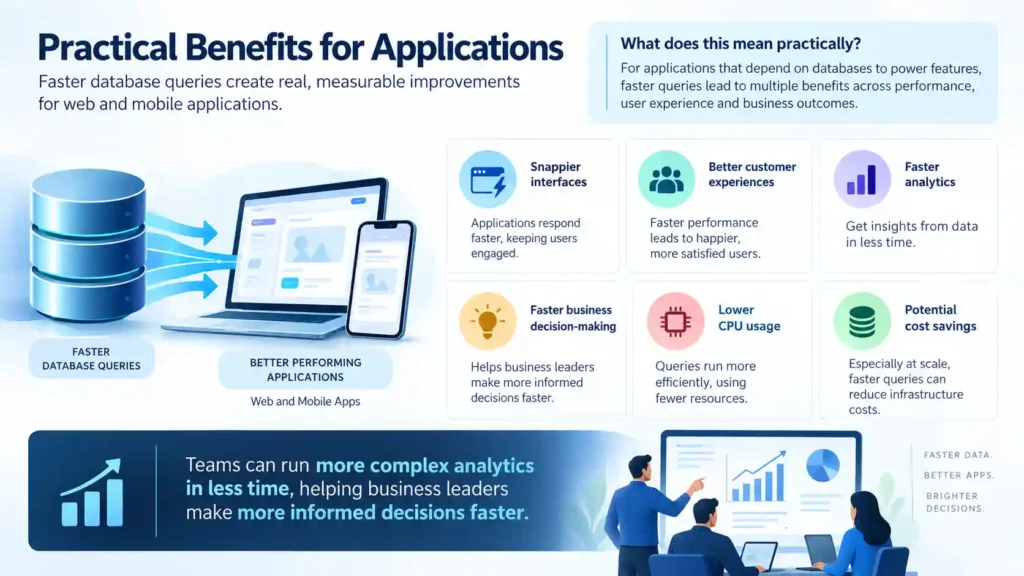
Teams can run more complex analytics in less time, helping business leaders make more informed decisions faster.
Where AI Query Planners Excel
Moreover, these AI-augmented query planners excel in scenarios where specific queries run repeatedly, such as dashboards or scheduled reports.
While upfront training requires running queries multiple times to gather feedback, the payback comes with continuous gains as the model proposes systematically better plans for frequent workloads.
Considerations for Adoption
Of course, adopting AI-driven query planning requires thoughtful integration.
Businesses should consider:
- Their specific workloads
- The frequency of critical queries
- Infrastructure to support additional training and measurement processes
Achieving stable, noise-minimized execution timing demands appropriate database configuration and dedicated environments for training.
The real power emerges when AI enhancements are seamlessly embedded into existing data pipelines and applications to accelerate existing processes without disrupting them.
The Bigger Picture
At the intersection of AI and core database technologies, this innovation highlights a broader lesson: technological advances deliver transformative value when adapted to real-world business workflows.
Raw AI capabilities alone won’t optimize databases effectively without tuning and integration.
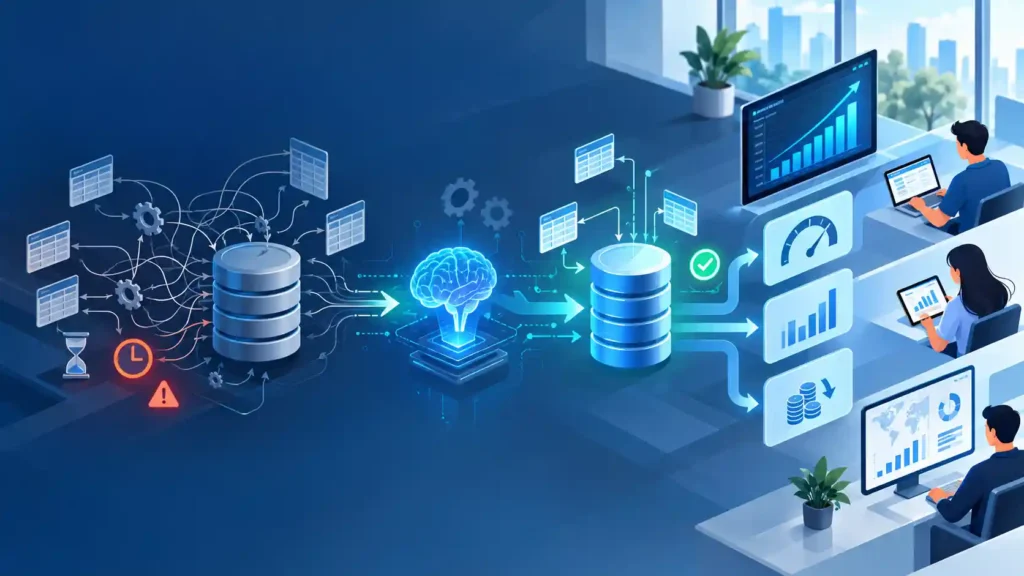
Modern businesses striving for agile, scalable, and cost-effective data management can leverage these AI-powered planners to unlock substantial improvements with practical impact across applications and analytics.
By rethinking fundamental database internals with AI, companies have a new lever to enhance performance, cut costs, and accelerate digital transformation.
This next generation of optimization offers prospects to not just keep pace with growing data demands but to power smarter, faster, and more responsive business operations.
Let’s Build This Together
At Manisoft Solutions, we help businesses turn ideas like this into practical software, AI, and automation solutions. If you see an opportunity to apply this kind of technology to your business, Get a free consultation and let’s talk.