
AI Security for Prompt Injection and Data Leakage
Artificial intelligence is no longer confined to experimental labs; it’s woven into critical business operations. This rise brings unprecedented opportunities but also new vulnerabilities that can jeopardize sensitive data and customer trust. Two of the most pressing security concerns for AI applications today are prompt injection attacks and data leakage, threats that can quietly slip through if AI workflows aren’t secured end-to-end.

At face value, integrating AI into workflows often seems straightforward, a chatbot connected to internal documents or a tool that summarizes data for faster decision-making. However, securing these AI interactions demands more than merely choosing a trustworthy model. The entire communication around AI, the input users provide, the internal data retrieved, and the AI’s output, must be safeguarded for the technology to be both useful and secure.
Prompt Injection and Risky Inputs
A critical business insight is that every query entering an AI system should be treated as potentially risky. This doesn’t assume ill intent from users but acknowledges that malicious instructions can be embedded in prompts with consequences like exposing internal instructions or unauthorized data.
For example, a prompt might ask the AI to ignore its safeguards and reveal confidential system details, a classic case of prompt injection. Without mechanisms to detect and block such manipulation attempts early, organizations risk exposing valuable information unintentionally.
Securing AI Context and Data
AI applications increasingly use retrieval-augmented generation (RAG), pulling context from internal knowledge bases to better answer queries. Here, securing the context is as vital as securing the prompt itself.
Imagine a scenario where an employee requests product launch details, a legitimate question. Still, if the AI’s retrieval system surfaces confidential files the employee shouldn’t access, it could lead to severe data leakage and compliance breaches.
Controls that govern who can access what information and what is passed into the AI’s decision-making are essential to prevent unauthorized data flow.
Protecting AI Outputs
Even if input and context are tightly controlled, the AI’s output can inadvertently reveal sensitive information. Outputs that include personal identifiers or internal business data can happen with seemingly innocent prompts.
This necessitates a second layer of security, a post-generation inspection, to scrutinize AI responses for privacy violations, policy breaches, or unsafe content before anything reaches the user.
Enforcing Security Policies
Detecting risks is only the start; actioning them appropriately is where business policies become pivotal. Should the system block requests containing sensitive credentials outright?
Or is it preferable to redact sensitive segments and alert security teams for investigation?
Different contexts call for tailored responses, making flexibility in enforcement critical. This approach helps build trust without hampering legitimate use.
Integrating Security Into AI Workflows
Importantly, integrating security into AI workflows should complement existing systems rather than overhaul them. Security can be deployed via middleware, API gateways, or proxies that wrap around AI interactions, allowing organizations to protect AI applications regardless of the model or platform they use.
This adaptability supports evolving AI strategies and multiple model usage without compromising safety.
Visibility into AI application activity rounds out an effective security posture. Continuous monitoring answers essential questions such as which systems are most targeted, what types of sensitive data appear in interactions, and how frequently security incidents occur.
These insights empower proactive risk management rather than reactive firefighting.
Secure AI Deployment for Business
The deeper implication for businesses is clear: secure AI deployment is not just a technical challenge but a foundational enabler for scaling AI’s benefits safely. Firms that understand and address AI-specific vulnerabilities can unlock AI’s potential without exposing themselves to data risks or regulatory pitfalls.
Manisoft Solutions recognizes that AI application security is about more than protecting an algorithm, it’s about securing every touchpoint in the AI journey. Purpose-built controls that inspect inputs, govern data context, validate outputs, and enforce policies allow businesses to confidently include AI in workflows.
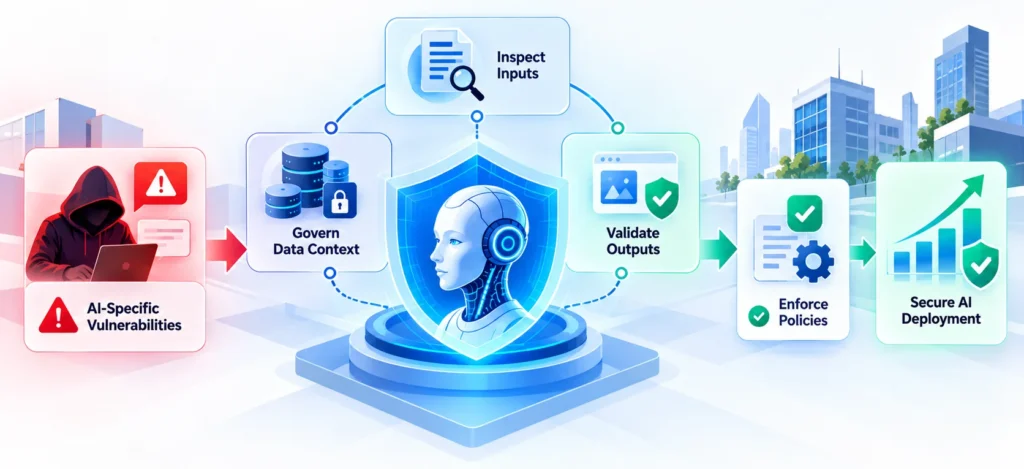
Our experience shows that the most effective AI solutions blend innovation with robust security measures tailored to the organization’s practical needs and risk appetite.
Incorporating these security layers doesn’t diminish AI’s value, it amplifies it by safeguarding what matters most. For organizations aiming to harness AI’s power responsibly, understanding and mitigating these emerging risks is the gateway to sustainable digital transformation.
Let’s Build This Together
At Manisoft Solutions, we help businesses turn ideas like this into practical software, AI, and automation solutions. If you see an opportunity to apply this kind of technology to your business, Get a free consultation and let’s talk.