
AI Privacy and Speed with Tiny Language Models
Traditional AI systems often rely heavily on cloud infrastructure to process complex language tasks, but this centralized approach strains data privacy, introduces latency, and generates ongoing infrastructure costs.
An emerging technology shift is changing how businesses think about AI deployment: tiny, efficient large language models (LLMs) are now capable of running directly on client devices and edge hardware , such as browsers, smartphones, or even microcontrollers , without relying on cloud servers. This breakthrough presents practical advantages that can reshape AI’s role in business operations.

The core challenge for many businesses is balancing AI’s power with privacy and operational efficiency. Sending sensitive information back and forth between user devices and cloud servers opens privacy risks and compliance concerns, while relying on cloud AI limits responsiveness when connectivity is poor or intermittent. Additionally, cloud-based AI services come with escalating costs tied to per-use pricing and server maintenance.
Tiny Language Models for On-Device AI
Tiny language models , significantly compressed AI models specialized for narrow, task-specific functions , address these issues by running calculations directly on local hardware.
Thanks to advanced model compression techniques, these models can be as small as 25 to 360 million parameters and fit comfortably within typical device memory limits. By executing AI workloads on-device, businesses can unlock several consequential benefits:
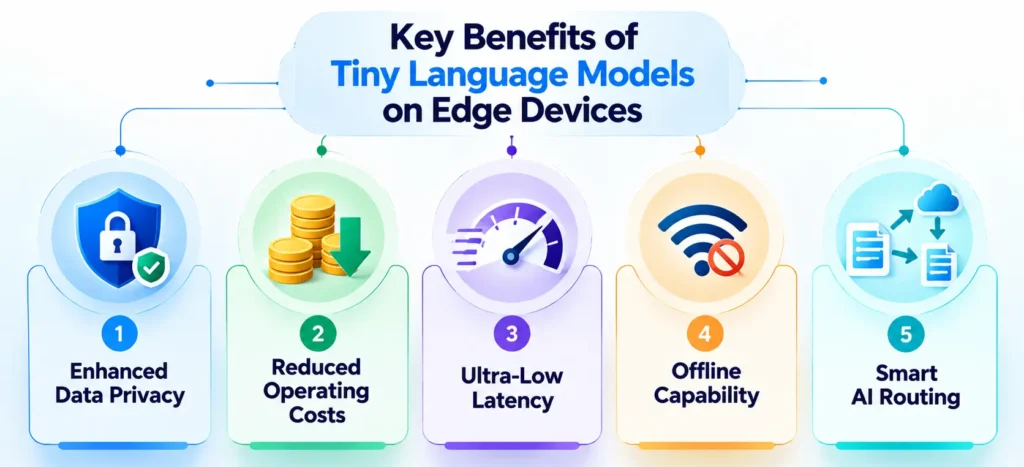
• Enhanced Data Privacy: Since no user data or prompts leave the device, data stays fully private and compliant with regulations. This is especially critical in sectors like healthcare, finance, and legal services where confidentiality is paramount.
• Reduced Operating Costs: Eliminating dependence on cloud servers removes subscription and API-call fees, while enabling limitless simultaneous users without extra infrastructure investment.
• Ultra-Low Latency: On-device models deliver instant AI responses, sometimes in under 10 milliseconds, enabling smooth user interactions and real-time decision-making without network-induced lag.
• Offline Capability: AI functions remain available regardless of internet connectivity, perfect for remote locations or scenarios with privacy-minded air-gapped environments.
• Smart AI Routing: Local models can perform quick triage functions , like query classification or spam filtering , to decide if more complex cloud AI processing is necessary, optimizing resource use.
Practical Applications and Business Impact
Businesses that integrate these tiny models into web or mobile applications get a new level of sophistication in user experience and operational agility.
For example, customer service tools can instantly interpret intent or categorize inquiries privately and efficiently on the user’s device before escalating to cloud AI only when needed.
Similarly, IoT sensors embedded with small language models enhance edge intelligence, enabling smarter automation without constant cloud interaction.
Considerations for Adoption
However, adopting this approach requires thoughtful alignment with business workflows and user needs.
Not all AI tasks can yet be handled by tiny models , large-scale generative or creative requests typically still require cloud resources.
Also, enabling hardware acceleration like WebGPU on browsers boosts performance dramatically, so ensuring devices support such technologies is key to unlocking full potential.
From Centralized AI to Decentralized Intelligence
From a strategic perspective, this paradigm signals a move from centralized AI towards decentralized intelligence that respects privacy and scales cost-effectively.
Businesses that explore embedding these edge LLMs gain practical advantages in user trust, responsiveness, and operational resilience.
At the heart of this transformation is the recognition that powerful AI need not become synonymous with massive cloud dependency.

By embedding tiny language models in client applications and edge devices, companies can embed AI deeply into everyday workflows with new efficiency and privacy guarantees. This shift invites innovation in everything from automated support agents to embedded IoT insights , ultimately expanding the possibilities for AI to create meaningful business impact.
Technology’s true value emerges when tools align seamlessly with real work. Tiny, efficient LLMs running on edge devices offer a compelling new dimension in that alignment, making AI integration smarter, faster, and more private.
For organizations considering smarter AI strategies, the rise of these compact models opens fresh avenues worth exploring.
Let’s Build This Together
At Manisoft Solutions, we help businesses turn ideas like this into practical software, AI, and automation solutions. If you see an opportunity to apply this kind of technology to your business, Get a free consultation and let’s talk.