
Unlocking AI Innovation with Open-Weight Language Models
The landscape of AI software development is undergoing a significant shift, one that promises to reshape how businesses integrate intelligent automation and scale innovation. The recent emergence of open-weight large language models (LLMs) dismantles longstanding barriers to AI adoption, offering an unprecedented route to create tailored, high-performing AI solutions without the heavy dependency on costly proprietary systems.

For many organizations, deploying AI has been constrained by access: proprietary AI models require expensive licenses or API usage fees, limiting experimentation and customization to meet specific business workflows. Open-weight LLMs change this dynamic by releasing the full model weights under accessible licenses, allowing companies to run, modify, and fine-tune these models internally. This shift opens a new frontier of agility and control.
Scale, Efficiency, and Adaptability
What makes open-weight LLMs particularly compelling is their combination of scale, efficiency, and adaptability. Newer models are designed to be powerful yet leaner in operational costs , delivering high reasoning and coding capabilities at a fraction of the compute expense typical of models with similar or even larger parameter counts.
This efficiency means that open-weight models can serve as the engine for AI-enhanced software that handles complex tasks such as:
- Coding assistance
- Multi-step reasoning
- Workflow orchestration
- without prohibitive infrastructure investment.
The practical impact on business software is profound. With open-weight models, companies can embed AI agents more deeply into their operations to automate repetitive coding, extract insights from large datasets, or create intelligent tools that guide decision-making. The flexibility to fine-tune models to domain-specific languages or operational nuances makes it easier to craft AI companions that integrate seamlessly with existing enterprise systems, enhancing both employee productivity and customer experiences.
Moreover, the open nature of these models fosters a broader innovation ecosystem. Developers and organizations worldwide can collaborate, share improvements, and build diverse applications without waiting on proprietary providers. This democratization accelerates AI solution creation, particularly for workflow automation and integration scenarios where bespoke AI can unlock new efficiencies and capabilities.
Planning for Adoption
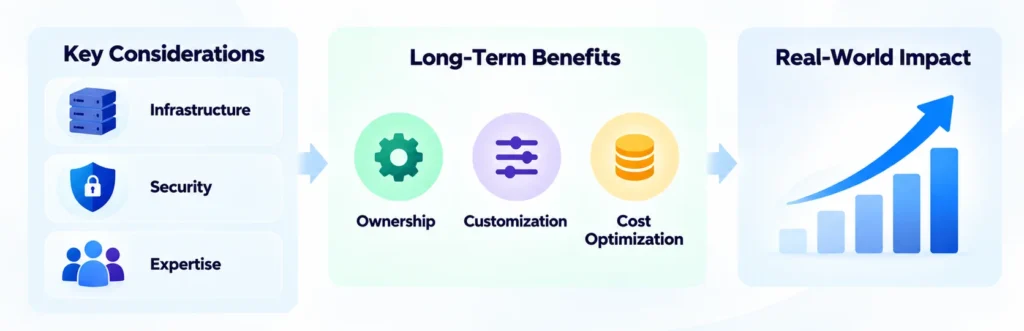
However, adopting open-weight LLMs also invites careful planning. Running these models internally demands appropriate infrastructure, security considerations, and expertise to maintain performance and align AI behavior with business requirements.
Yet, for many, the long-term benefits of:
- Ownership
- Customization
- Cost optimization
We’ve observed that the pivotal advantage lies in bridging the gap between raw AI capability and real-world workflows. Embedding open-weight LLMs into thoughtfully designed software solutions transforms them from experimental tools into practical assets that streamline operations and unleash innovation at scale.
At the intersection of open AI models and business software development, the opportunity is to harness accessible, efficient intelligence engines to build the next generation of automation and decision support systems.
This approach not only reduces reliance on external providers but also empowers organizations to tailor AI to their unique challenges , transforming potential into measurable results.
Let’s Build This Together
At Manisoft Solutions, we help businesses turn ideas like this into practical software, AI, and automation solutions. If you see an opportunity to apply this kind of technology to your business, Get a free consultation and let’s talk.