
Autonomous AI Agents for Real-Time Workflow Escalations
In many enterprise operations, a recurring dilemma persists: how to maintain customer engagement and support responsiveness while scaling complex workflows efficiently. The reality is that manual interventions and delayed escalations often create friction points, snuffing out the momentum of critical business interactions. Autonomous AI agents are emerging as powerful orchestrators, seamlessly managing real-time routing and escalation within business processes , a transformation with significant implications for operational agility and customer satisfaction.
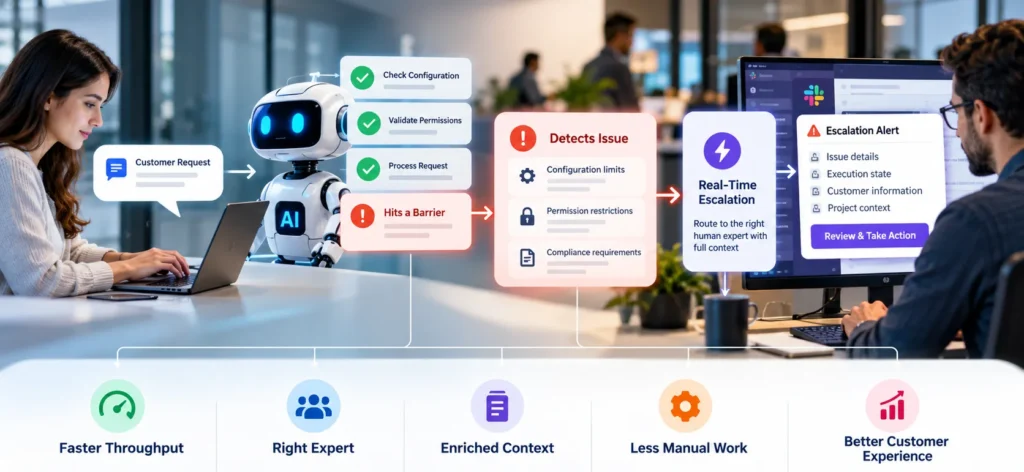
Autonomous AI agents function as active participants in workflows, not simply tools operating in isolation. They can detect when a process encounters a barrier , such as hitting configuration limits, permission walls, or complex compliance requirements , and immediately trigger a defined escalation to expert human operators. This dynamic interception prevents workflow abandonment, which is particularly vital in scenarios like technical sales evaluations where customer interest can dissipate rapidly if the system stalls.
Balancing Automation and Human Intervention
One of the biggest challenges enterprises face today is the balancing act between automating routine interactions and promptly addressing exceptions that require human judgment. Traditional escalation methods, such as email tickets or delayed callbacks, fail to meet the speed and context-sensitive demands of modern business processes, often causing critical opportunities to slip away. Autonomous agents paired with real-time orchestration platforms flip this paradigm by capturing deep session context and routing issues instantly to the right resource within communication hubs like Slack.
The practical advantage here is twofold.
First, throughput accelerates because agents can signal escalation points as soon as they arise, nudging the process forward without unnecessary wait times.
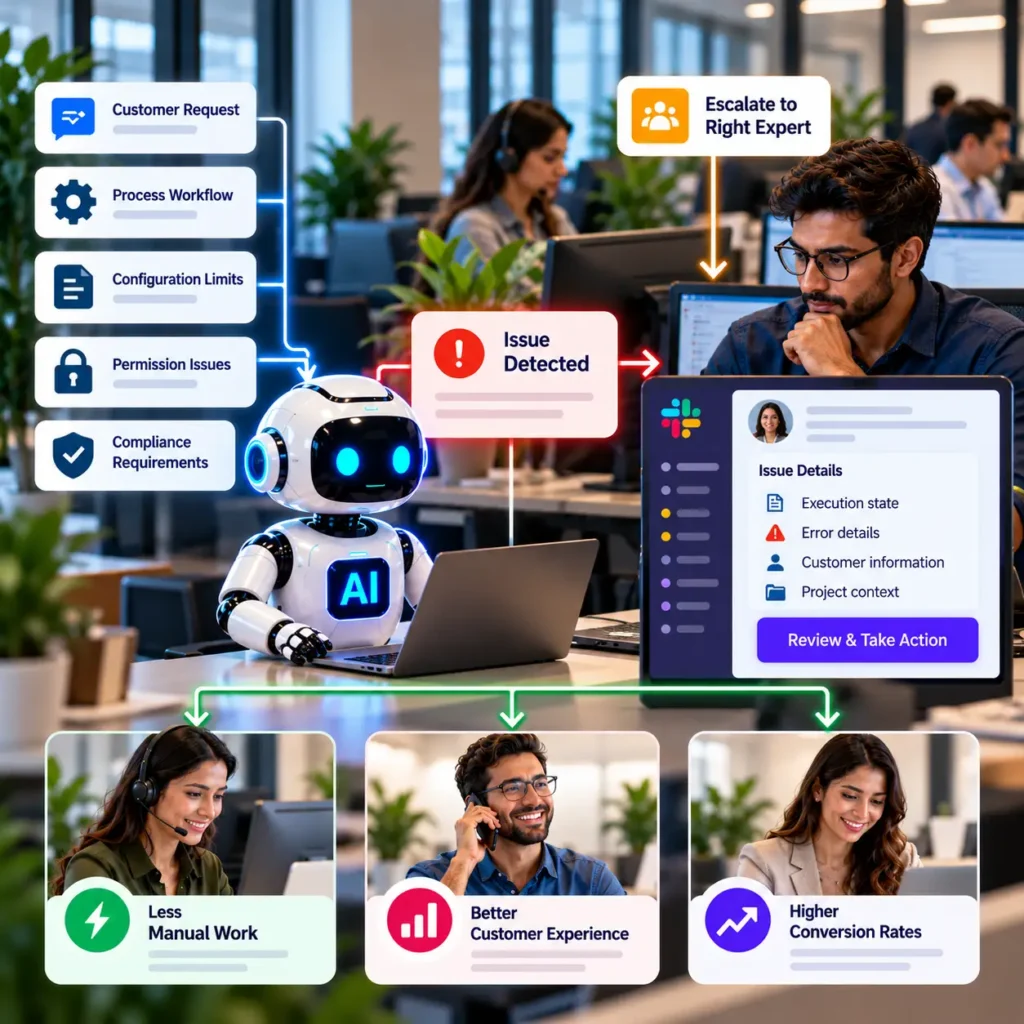
Second, human experts receive enriched, actionable data , including execution states, error details, and relevant customer or project information , all consolidated into a single interface. For example, a technical account executive can quickly assess where an autonomous agent encountered a network restriction, understand the prospect’s history, and directly intervene through one-click actions without searching for background information.
Scaling Real-Time Workflow Escalations
Integrating autonomous AI agents into real-time business workflows can drastically reduce the manual burden traditionally borne by support and sales teams. Rather than spending time chasing down needed context or reacting to delayed alerts, staff can engage proactively and precisely, leading to improved customer experiences and higher conversion rates. Importantly, the escalation process itself scales effortlessly as more workflows become partially or fully automated, avoiding bottlenecks that usually emerge in high-volume environments.
However, businesses seeking to adopt this technology should carefully consider the design of human-in-the-loop escalation frameworks. Automated detection is only as valuable as the responsiveness and capabilities of the teams receiving alerts. Establishing clear service level agreements (SLAs), defining escalation priorities based on issue types, and enabling intuitive interaction within collaboration tools are essential for maintaining momentum and trust.
Orchestrating AI and Human Expertise
From a strategic perspective, autonomous AI agents represent not just a technological improvement but a shift in operational mindset. The goal moves from eliminating all human touchpoints to orchestrating a fluid partnership between AI and human expertise, where AI handles routine navigation and signals humans precisely when needed. This model fosters agility, maximizes resource efficiency, and keeps workflows aligned with business objectives.
At Manisoft Solutions, we see the bigger opportunity in tailoring autonomous agent integrations to real business workflows rather than off-the-shelf automation. By mapping existing operational friction points and carefully embedding escalation intelligence within familiar employee tools, companies can unlock scalable automation without sacrificing nuance or responsiveness. The business benefit is a smoother customer journey, quicker decision cycles, and a stronger competitive edge.
Real-Time Workflow Escalations and Digital Transformation
In conclusion, autonomous AI agents orchestrating real-time workflow escalations offer a compelling approach for enterprises aiming to scale customer engagement and operational efficiency. When implemented thoughtfully, they convert potential failure points into moments of value creation , connecting intelligent automation with just-in-time human insight. This blended approach is rapidly becoming a cornerstone of digital transformation for businesses ready to embrace automation that serves people, not replaces them.
Let’s Build This Together
At Manisoft Solutions, we help businesses turn ideas like this into practical software, AI, and automation solutions. If you see an opportunity to apply this kind of technology to your business, Get a free consultation and let’s talk.