
Harnessing Local Servers and Idle Compute for Cost-Effective AI Deployment
AI adoption in business is often held back by rising cloud costs, concerns about data privacy, and latency issues that hinder responsiveness. Traditional reliance on centralized cloud AI services means recurring fees and data travel across the internet, exposing sensitive information and slowing down operations. This has led to a growing shift toward decentralizing AI workloads, a transformation that opens compelling opportunities for cost-efficient, private, and responsive AI solutions.
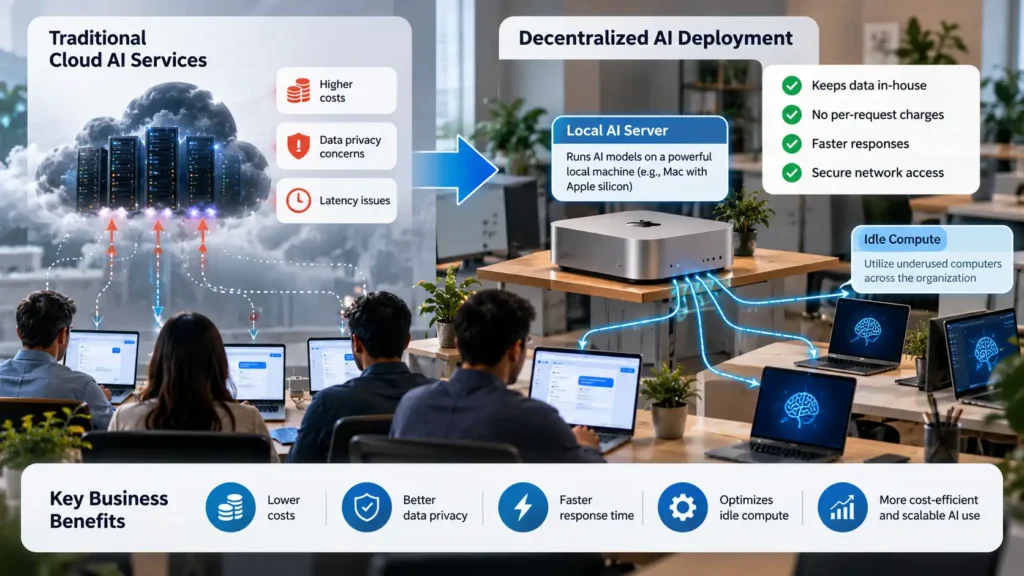
The core of this shift lies in two complementary strategies: running AI models on local servers and intelligently utilizing idle compute on existing devices. Instead of outsourcing every AI request to costly cloud platforms, enterprises can leverage a powerful local machine, like a Mac equipped with Apple silicon, to act as a shared AI server on a secure network. This approach keeps sensitive data in-house, eliminates per-request cloud charges, and enables teams to interact with AI models with minimal delays.
Simultaneously, distributing AI workloads across idle computers within an organization optimizes underused computational assets. When employees’ devices are not actively engaged in heavy tasks, their processing power can be harnessed to serve AI models or assist heavier nodes in processing requests. This distributed model reduces the dependency on centralized resources and spreads the computational load in a cost-efficient manner.
Business Benefits of Decentralized AI
For businesses, these techniques address multiple pain points. First, the financial burden of cloud AI services can be significantly lowered, since fewer requests need external processing. Second, keeping AI computations local or within the corporate network enhances data privacy, reducing risks related to compliance and confidential information leaks. Third, responsiveness improves as data packets no longer traverse distant cloud servers, creating faster feedback loops in AI applications such as customer support chatbots or internal analytics.
However, decentralized AI also requires thoughtful planning around capacity and workflow management. A local AI server’s ability to handle simultaneous users depends on its memory and processing power. Configurations can be adjusted to balance speed and concurrency, ensuring teams receive timely responses without overwhelming hardware. Additionally, securing access through API keys and restricting network exposure protects local AI services from unauthorized use.
Managing Idle Compute and Distributed Workloads
Integrating idle compute resources introduces complexity in orchestrating which devices handle tasks and when. Efficient scheduling and fallback options must be devised to maintain smooth performance, especially in mixed environments where devices have varying availability and capabilities. Yet, with well-implemented automation, this hybrid model creates a resilient ecosystem that optimizes both hardware investments and operational costs.
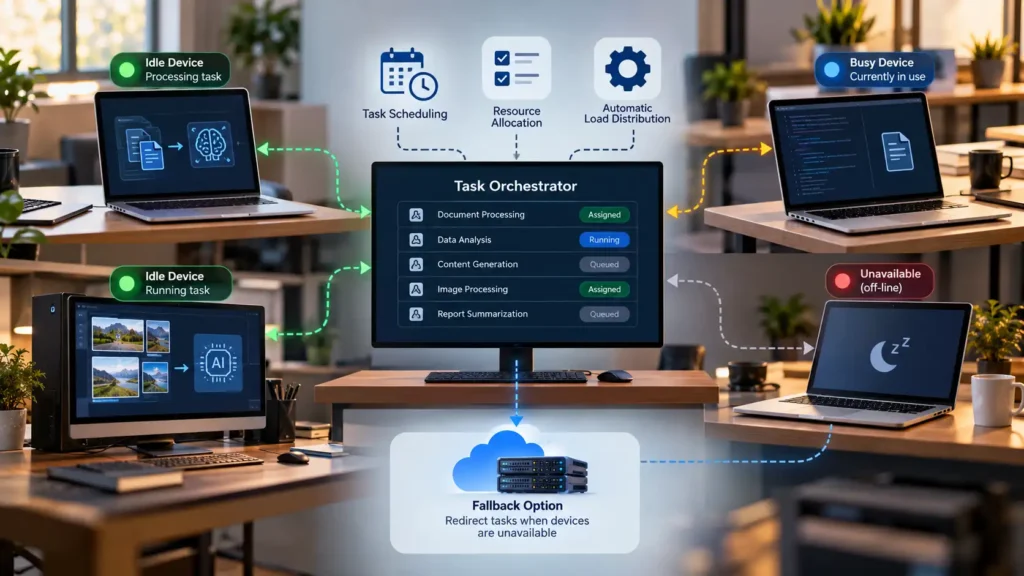
We see significant opportunity in this hybrid approach, mixing local AI hosting with idle compute distribution. It enables businesses to break free from rigid, cloud-dependent AI workflows and tailor AI deployment to their unique operational landscapes. Whether automating document processing, enhancing team collaboration with customized AI tools, or powering responsive customer insights, decentralized AI lowers barriers and promotes innovation.
Implementing Decentralized AI in Business
Businesses considering this path should evaluate their existing infrastructure, aiming for a local server with enough capacity to support typical use cases and a reliable network connecting team devices. Ensuring clear policies for access control and ongoing monitoring will safeguard both performance and security. Over time, exploring distributed compute can further stretch AI capabilities without large capital expenditures.
Ultimately, technology achieves value when aligned with real-world workflows and business needs. Decentralized AI deployment offers a practical advantage for organizations balancing cost, privacy, and performance pressures. By leveraging local servers and idle computing power, companies can build smarter, more cost-effective AI solutions that truly fit their operational rhythm.
Let’s Build This Together
At Manisoft Solutions, we help businesses turn ideas like this into practical software, AI, and automation solutions. If you see an opportunity to apply this kind of technology to your business, Get a free consultation and let’s talk.