
Reliable Workflow Automation with API Failure Handling
As businesses increasingly depend on connected applications interacting through automated workflows, the invisible hand of third-party APIs often becomes a point of both power and vulnerability.
When these external APIs become slow, unreachable, or send unexpected errors, the consequences ripple through automated processes, causing operations to stall, duplicate, or fail quietly but disruptively.

Automation is usually perceived as a flawless sequence once set. Yet, the reality is that reliability in workflow automation is a design challenge, not something that can simply be toggled on after the fact. The core tension lies in managing the different ways third-party APIs can fail and ensuring the whole automation doesn’t collapse because of it.
Understanding the Different Types of API Failures
Failures typically fall into three meaningful categories.
Transient failures like timeouts and rate limits often resolve themselves if the system waits and tries again.
Permanent failures such as unauthorized access or invalid data require immediate human attention.
Partial completion errors, where some steps succeed but subsequent calls fail, pose the greatest threat by creating inconsistent or duplicate business records when naïvely retried.
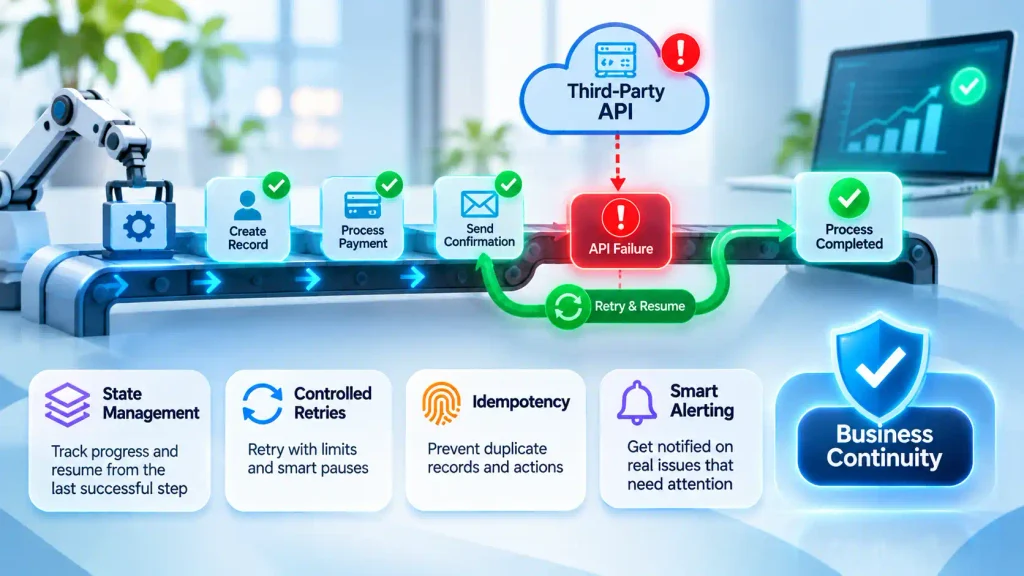
The business risk in ignoring these failure modes is significant. Imagine an automation that creates a customer record, attempts payment processing, then sends confirmation.
If payment processing fails but the workflow retries everything from the start, customers might be billed twice or important records duplicated, causing financial confusion and eroding trust.
Designing Workflows That Can Recover From Failures
A shift in mindset and architecture is needed. Instead of building linear workflows that assume every step always succeeds, designers should break down processes into discrete, state-aware stages.
Each stage verifies if its task was already completed, stores the outcome and any related external IDs, and only then moves on. This way, if a failure occurs, the automation can resume exactly where it left off after remediation or retry.
Equally important is managing retries with clear limits and nuanced logic. Blindly repeating failed calls only worsens issues like rate limiting or locks accounts due to repeated invalid authentication attempts.
A strategic retry budget, limited attempts with pauses, enables transient errors to recover without overwhelming the system.
The Role of Idempotency in Preventing Duplicate Operations
Idempotency plays a crucial role here as well.
Where APIs support it, sending an identical transaction key with each request prevents accidental duplication. Where this isn’t supported, the workflow itself must track unique keys for business events to skip repeated creation of records or actions.
Monitoring and Alerting for Reliable Automation
Monitoring and alerting should focus on exceptions that genuinely need human intervention, not every minor error or retry.
Smarter alerts for jobs stuck in failure beyond retries, authentication errors, or aging incomplete tasks help keep attention focused and avoid alert fatigue.
Building automation with these principles demands more upfront effort and thoughtful design, but delivers workflows that can be trusted to operate without constant babysitting. This enhances operational continuity, reduces downtime, and preserves data integrity.
Building Resilient Automation for Business Continuity
In practice, this means automation solutions should become more than a string of connected tasks; they must evolve into resilient processes that understand state, handle imperfections in integrations gracefully, and communicate clearly when intervention is required.
For businesses, embracing this approach means their automation investments become reliable extensions of operations instead of occasional liabilities. These resilient workflows protect against common pitfalls of integration reliance, helping maintain smooth customer experiences and accurate business records even when external services falter.
At the intersection of design and technology, organizations are encouraged to view automation resilience as a strategic priority. This involves focusing on idempotency, state management, controlled retries, and smart alerting rather than just expanding automation volume.
Prioritizing quality and reliability will unlock deeper value and greater confidence in automation’s promise.
Ultimately, the most effective automation shifts the business forward by seamlessly bridging internal processes with external systems, even when those external systems don’t behave perfectly. A well-architected resilient workflow lets businesses reap the rewards of automation with less risk and operational disruption.
Supporting these resilient workflows requires expertise in workflow design, business process understanding, and integration nuances, all areas where tailored software solutions and consulting can apply best practices to practical workflows. That’s when technology moves from experimental projects to reliable engines of productivity.
Let’s Build This Together
At Manisoft Solutions, we help businesses turn ideas like this into practical software, AI, and automation solutions. If you see an opportunity to apply this kind of technology to your business, Get a free consultation and let’s talk.