
How AI Automation is Solving Real Business Workflow Challenges
Businesses today face a persistent challenge: manual, repetitive tasks drain time and resources across critical workflows like product content creation, video indexing, and operational monitoring. While companies understand the value of automation, generic AI agents often struggle to address these specific pain points effectively. What’s truly changing is the rise of specialized AI applications designed to integrate seamlessly into real business processes , transforming how work gets done.

Consider an example in eCommerce, where sellers must frequently generate detailed product listings for multiple platforms. Writing compelling, SEO-friendly descriptions can consume hours of manual effort and often produces inconsistent results. Now, AI-powered tools can take rough product notes and instantly produce polished listings tailored to platforms like Etsy or Amazon. This example highlights a broader move from one-size-fits-all AI towards purpose-built applications that automate distinct tasks, reduce errors, and scale easily.
AI-Powered Video Content Analysis
Another area benefiting from this shift involves video content analysis. Previously, indexing video data for searchability or person recognition required extensive manual tagging or expensive software. Emerging AI-powered solutions can now analyze video real-time to identify people or objects without human intervention, vastly improving speed and accuracy. For businesses, this means workflows that once tied up teams can be streamlined, enabling faster insights and enhanced customer experiences.
Business Benefits of AI Automation
The practical business implications are considerable. By embedding AI closely into workflow automation, companies can free employees from repetitive content creation or monitoring roles, allowing focus on higher-value activities. Processes become not only faster but also more consistent since AI applications apply standardized best practices and reduce human error. Such improvements drive productivity and open avenues for scaling operations without proportional increases in headcount or cost.
Integrating AI into Existing Workflows
Yet, adopting AI applications requires thoughtful integration. Businesses should evaluate whether an AI tool truly fits an existing workflow rather than forcing unnatural changes. Transparency about AI capabilities and limitations is critical to maintain trust internally and externally. Moreover, leveraging AI models that are open and customizable, rather than locked behind costly proprietary systems, can enhance flexibility and long-term viability.
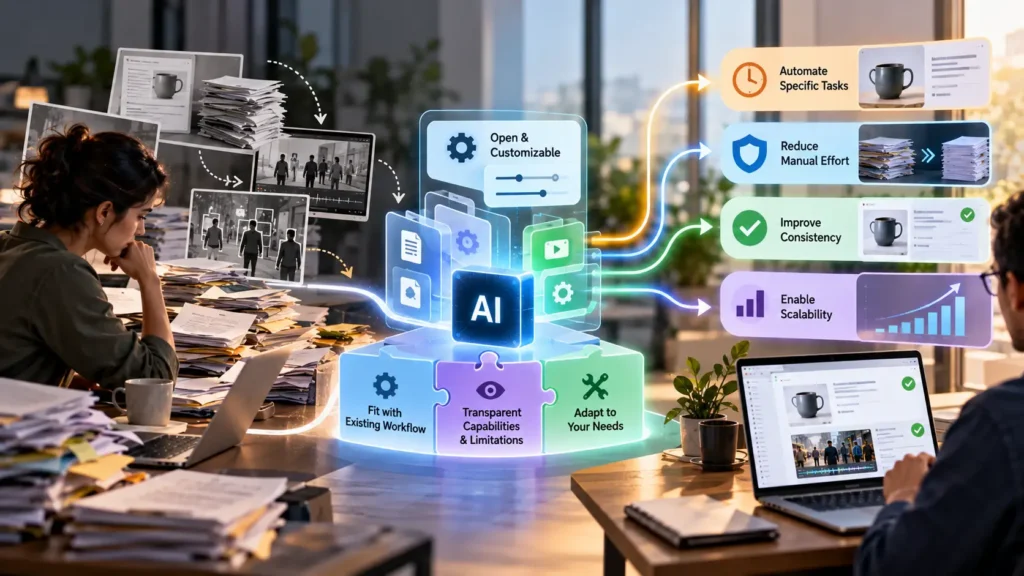
This trend signals a maturing phase in AI automation: moving beyond experimental bots towards specialized tools that address concrete workflows with measurable business impact. The future belongs to businesses that recognize this evolution and invest in AI solutions adapted to their unique operational needs.
At Manisoft Solutions, this perspective guides how software and AI are applied. Technology’s true value emerges when it is carefully aligned with real business processes to solve specific problems , not just for novelty, but for meaningful efficiency gains and scalability. As AI applications continue to diversify, integrating tailored automation tools will be an essential step for companies aiming to transform workflows and unlock new growth potential.
Let’s Build This Together
At Manisoft Solutions, we help businesses turn ideas like this into practical software, AI, and automation solutions. If you see an opportunity to apply this kind of technology to your business, Get a free consultation and let’s talk.