
AI Agent Automation: From Risk to Reliability
Automating complex business processes with AI agents promises considerable efficiency gains by reducing repetitive manual tasks and scaling operations. Yet the path to realizing these benefits is riddled with practical challenges, especially when AI agents handle tasks that directly affect customer transactions, such as processing refunds. Missing the mark here can lead to costly errors and customer dissatisfaction rather than operational improvements.
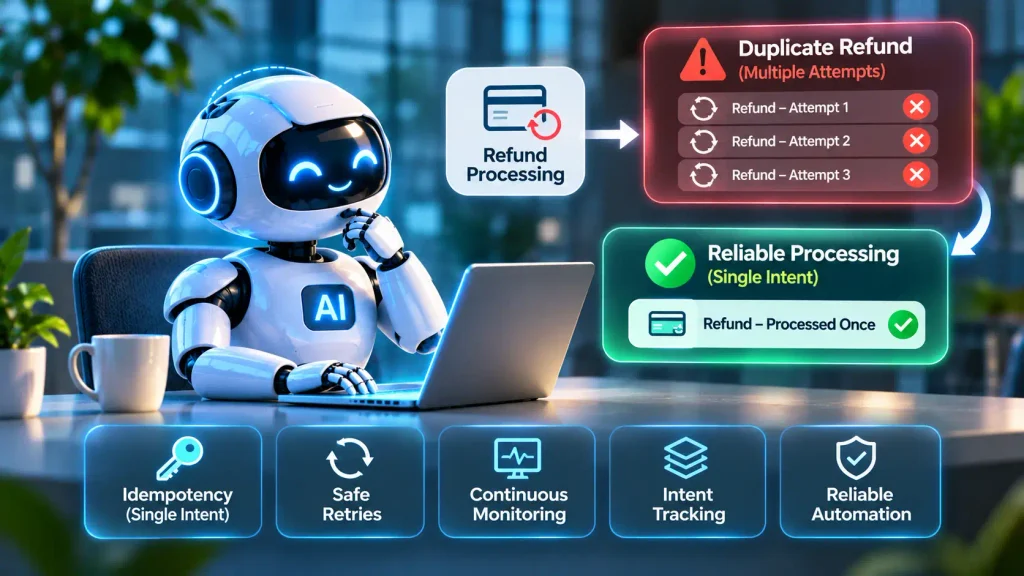
The critical issue often lies in how AI agents manage the side effects of their actions in automated workflows. Consider refund processing: it involves a financial transaction that must occur exactly once per customer intent, no more. However, AI agents deployed to trigger refunds in practice may unknowingly cause multiple refund attempts for the same order.
This usually results from how retries are managed across various system layers, agent logic, network clients, and even repeated user actions, all attempting to ensure success but inadvertently multiplying requests.
Managing Errors and Retry Mechanisms Safely
Moreover, error signals from downstream systems need fresh interpretation. Not every error means the action failed outright; some errors simply indicate uncertainty whether the action succeeded.
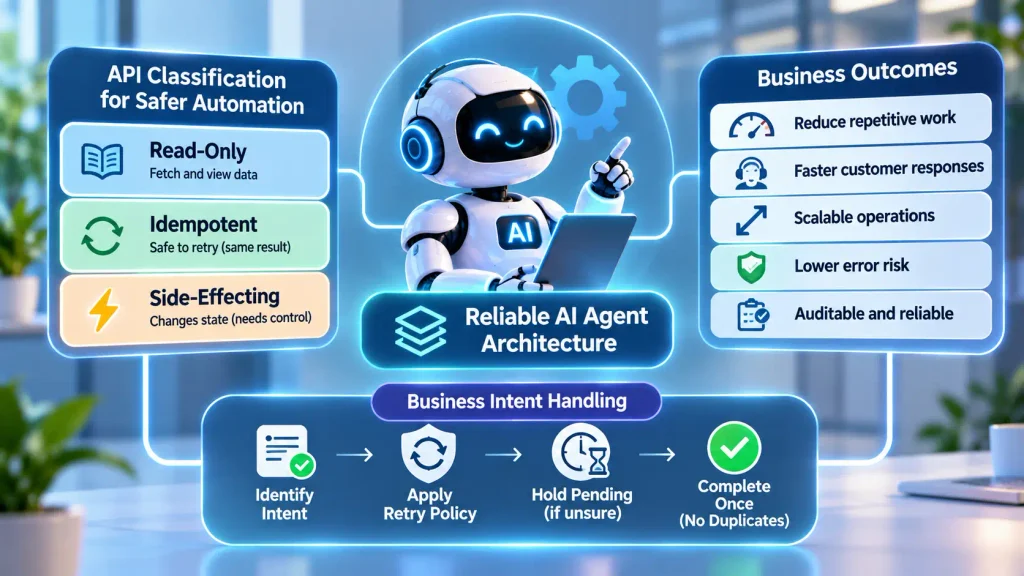
For workflows with side effects, such unclear errors must be treated cautiously to avoid blind retries. Instead, the system should mark the state as “pending unknown” and inform users or support teams to hold off on further attempts until the result can be reconciled.
Robust automated workflows will implement single wrappers around side-effecting actions. These wrappers enforce one-call-only semantics by querying a persistent record of intents and their states before proceeding.
They also handle retries carefully, allowing them only when the retry targets the same intent key and not when new call identifiers arise. Doing so transforms the unwieldy layers of retries from multiple independent callers into a coordinated retry policy aligned on business intent.
Monitoring and Maintaining Reliable AI Automation
Interestingly, many failures arise outside of development or deployment activities, sometimes weeks after a stable release. This highlights the importance of continuous monitoring, automated smoke tests that verify single-action idempotency during runtime, and periodic reconciliation jobs that cross-check intended actions against actual outcomes with external systems.
Alerts on duplicate actions can help react swiftly to unintended side effects, limiting customer impact.
Building Reliable AI Agent Architectures
For businesses evaluating AI agent deployments in automated workflows, the biggest lesson is clear: technology alone is not enough. Successful automation requires architectural decisions that respect the nuances of side-effect management, retry safety, and real-world operational observability.
This means classifying API calls into categories like read-only, idempotent, and side-effecting to shape retry policies appropriately. It also means designing prompts and instructions for AI agents that explicitly prevent unsafe retries and ensure they interpret responses in a way aligned with operational realities.
When done right, AI agents can reduce costly repetitive work, accelerate customer service response times, and make business processes scalable without increasing error risk.
The key is building automation that treats each business action as a distinct intent that can be safely retried or held pending without generating duplicates or confusion.
Adopting such disciplined practices unlocks the true promise of AI-driven automation, a future where workflows are not only faster but also reliably accurate and auditable. As AI agent technology advances, the focus should remain on embedding these real-world lessons into every implementation, turning automation risk into operational advantage.
This balance of innovation and caution is where automation providers can offer the most value: by adapting cutting-edge technology to fit the complexities of human workflows and business realities rather than expecting workflows to bend around technology constraints. It’s a nuanced approach that transforms AI agents from experimental tools into dependable pillars of modern enterprise operations.
Let’s Build This Together
At Manisoft Solutions, we help businesses turn ideas like this into practical software, AI, and automation solutions. If you see an opportunity to apply this kind of technology to your business, Get a free consultation and let’s talk.