
AI Automation for Small Businesses
Many small and informal businesses around the world continue to rely on manual, paper-based methods to manage crucial operations like sales tracking and credit management. This is particularly true in locations where internet connectivity is unreliable or nonexistent.
The challenge is that conventional AI automation solutions typically assume continuous connectivity and cloud access, creating a barrier for smaller merchants in underserved regions. Yet these businesses could gain significant operational efficiency, better customer insight, and growth potential by embracing AI-driven automation tailored to their unique environment.
1. AI Automation for Low-Connectivity Businesses
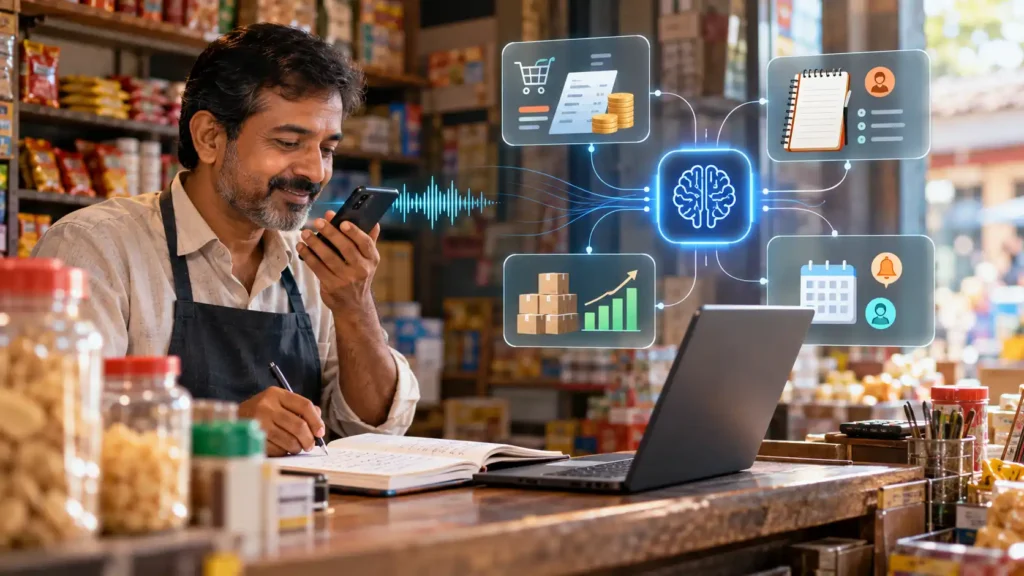
The core opportunity is to rethink AI automation so it works reliably on modest local hardware, independent of stable internet. By embedding AI models directly within a shop’s laptop or smartphone, processes like the following can be automated in near-real time:
- Transaction recording
- Credit tracking
- Inventory forecasting
- Customer reminders
This local-first approach eliminates dependence on external servers and avoids privacy concerns related to sharing sensitive customer data.
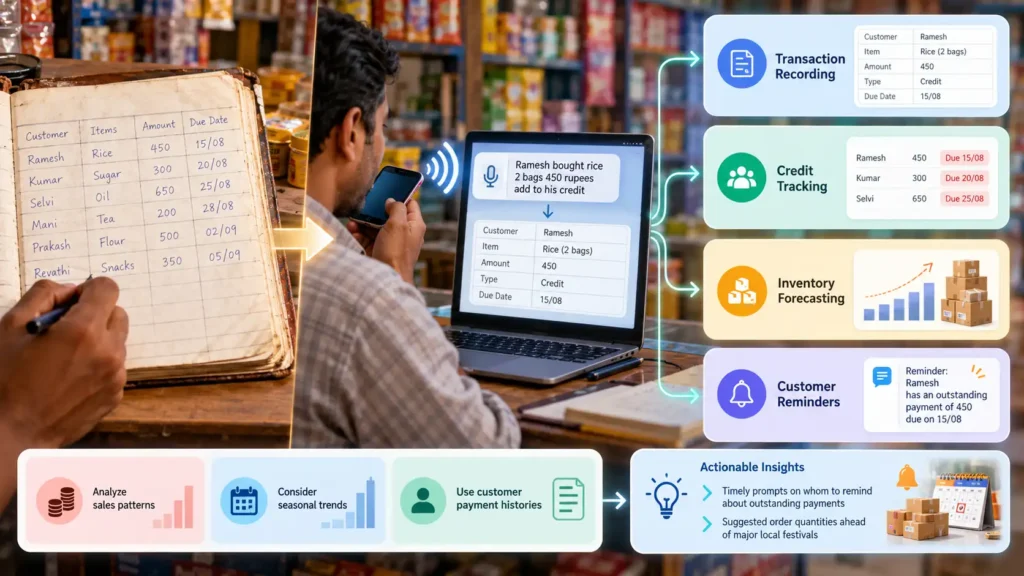
Consider the traditional credit ledger, a handwritten notebook that tracks which customers owe what, and when payments are due. It is simple, trusted, and deeply embedded in the daily flow of many small shops worldwide.
Replicating this in digital form requires systems that interface naturally with how shopkeepers speak and think, often mixing local languages with informal phrasing. AI models trained to understand and parse this mix can convert verbal or typed notes into structured digital records, making detailed daily bookkeeping faster and less error-prone.
Moreover, integrating predictive AI locally can revolutionize inventory management and credit risk assessment. By analyzing sales patterns, seasonal trends, and customer payment histories stored on-device, an AI agent can forecast product demand and highlight which customers might delay payments. This enables business owners to make informed decisions about stock replenishment and extending further credit on their own terms.
A key practical consideration is balancing accuracy and speed within the limited hardware typical of low-infrastructure contexts. Deploying a combination of straightforward rule-based processing for instant feedback, supplemented by more nuanced AI model refinement running in the background, offers a responsive and reliable experience during busy periods.
This hybrid approach respects the fast-paced nature of retail counters while ensuring data integrity.
Additionally, AI-generated actionable insights, for example, can support vendors in optimizing cash flow and inventory without requiring manual data analysis:
- Timely prompts on whom to remind about outstanding payments
- Suggested order quantities ahead of major local festivals
2. Business Benefits and Digital Transformation
The business value of such tailored AI automation is tangible:
- Reducing the time and effort spent on record-keeping
- Minimizing errors that lead to lost revenue
- Improving the customer experience through personalized, language-appropriate interaction
It also opens a path for small businesses to scale their operations and compete more effectively.
For companies working on digital transformation, the lesson is clear. Technology solutions must be adapted to the actual conditions and behaviors of the users, not the other way around.
Investing in AI that respects low-connectivity constraints, operates on affordable hardware, and understands local language nuances is critical to unlocking digital empowerment for small merchants globally.
This approach aligns well with broader trends emphasizing privacy, local data ownership, and affordable technology. It demonstrates that digital transformation is not solely about connecting everyone with high-speed internet but about smartly extending AI’s benefits into everyday contexts where connectivity is scarce.
At Manisoft Solutions, we recognize that meaningful automation emerges when innovative AI technologies meet real-world workflows. Leveraging our experience, we see these adaptations as a vital frontier for expanding AI’s business impact, transforming modest shops into efficient, data-informed enterprises without requiring radical infrastructure investments.
The future of AI automation for small businesses depends on making technology that fits their world and unlocks new opportunities for growth and sustainability.
Let’s Build This Together
At Manisoft Solutions, we help businesses turn ideas like this into practical software, AI, and automation solutions. If you see an opportunity to apply this kind of technology to your business, Get a free consultation and let’s talk.