
Building Trust in Autonomous AI
Businesses increasingly turn to AI agents to autonomously handle routine tasks within their workflows. These agents, equipped with growing autonomy to make changes and decisions, promise efficiency and scale. Yet this brings a fundamental tension: how can organizations be confident that AI agents perform actions reliably and correctly, without introducing errors or unintended side effects?
The Challenge of Validating Autonomous AI Actions
At the heart of this challenge lies validation, ensuring that an AI agent’s autonomous changes truly match the intended business outcome. Consider a seemingly simple task where an AI agent updates a single configuration field. To a human, this feels straightforward. But AI systems may navigate this task via various routes, interaction paths, or API calls, each carrying subtle differences in how success is measured or what side effects may occur.
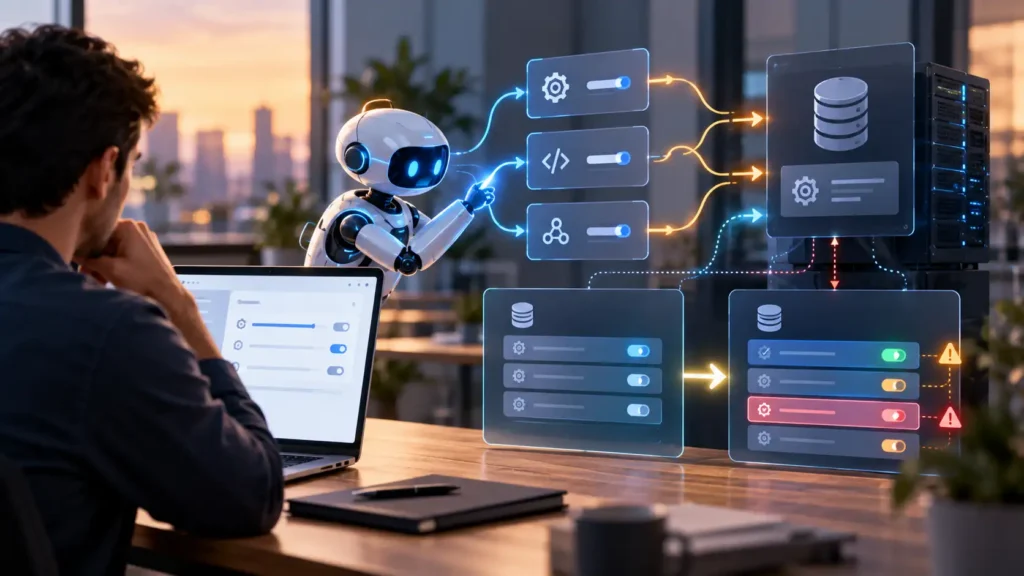
Without rigorous validation, an AI agent might correctly update the target field but inadvertently omit or alter other configuration elements. This gap happens because an accepted system response may only confirm compliance with validation rules rather than verify full alignment with the user’s intent. For enterprises, this creates risk: operational issues could arise from unnoticed collateral changes.
To confront this, validation has to become multi-layered and explicit. It requires comparing not just the immediate change request but also the broader state before and after execution. This means independently reconstructing the expected outcome and contrasting it with the agent’s actual request and resulting system state. Capturing detailed call traces and version histories adds another layer of assurance, revealing whether any unauthorized writes or unintended system states occurred.
Building Trust Through Independent Verification
Another critical insight is distinguishing between the agent’s intent to change and the system’s acceptance of that change. Sometimes, permission restrictions or errors prevent a write operation, but without such checks, it can be unclear if an attempted action really took place or was blocked. Consequently, continuous monitoring of requests combined with independent state verification is key to establishing trust.
Moreover, validation methods must be transparent and testable. Providing reproducible test cases, where known errors like accidental deletions are deliberately introduced, enables the robustness of validation to be demonstrated. Sharing these test materials with stakeholders fosters confidence that the validation process uncovers subtle failures rather than producing false positives.
From AI Experiments to Dependable Enterprise Automation
From a business perspective, this evolving emphasis on validation turns autonomous AI from a pilot experiment into a dependable workflow component. When organizations can systematically verify that AI agents act correctly at every step, they reduce operational risk and unlock the full benefits of scaled automation. Reliable validation supports automation adoption across diverse use cases, from configuration management to complex integration tasks, making AI agents truly autonomous collaborators rather than experimental tools.
At the strategic level, this shift means investing in monitoring and validation frameworks that mirror human judgment through automation. These frameworks must also capture and explain errors to support ongoing improvement, helping enterprises find where and why AI actions diverge from expectations.
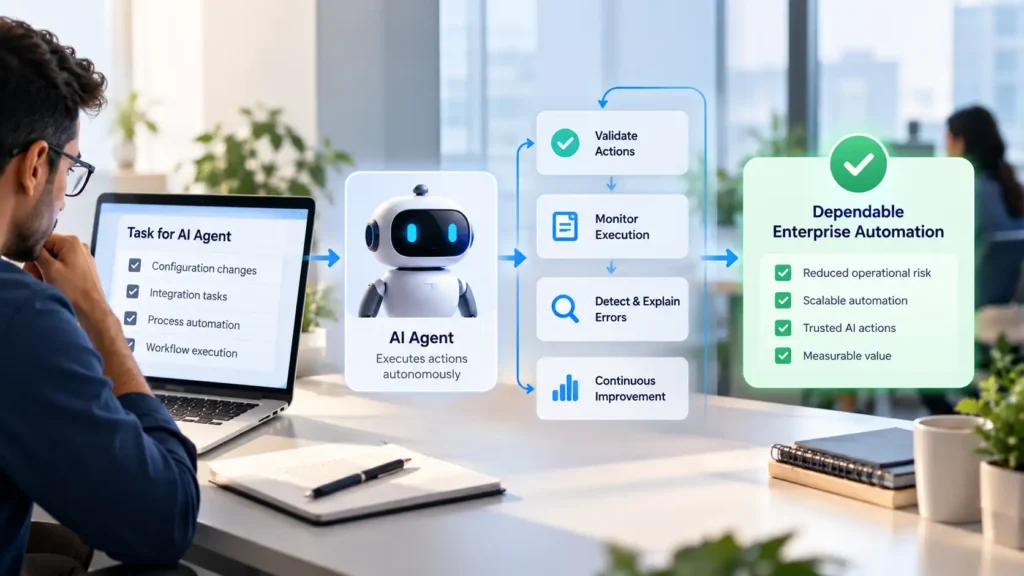
For businesses exploring AI-driven automation, the takeaway is clear: focus early on defining precise success criteria for AI actions, build layered validation around those criteria, and embed transparent diagnostics into workflows. This approach ensures AI systems not only perform tasks but can be trusted to perform them well, making AI automation a scalable and reliable asset.
Bringing this perspective into practical reality requires technology tailored to business processes. When automation, AI agents, and validation tools align with real operational needs, rather than generic technical capabilities, the resulting solutions provide measurable value and risk mitigation. This balanced approach transforms AI agents from automation hopefuls into trusted enterprise operators capable of handling meaningful autonomy.
Let’s Build This Together
At Manisoft Solutions, we help businesses turn ideas like this into practical software, AI, and automation solutions. If you see an opportunity to apply this kind of technology to your business, Get a free consultation and let’s talk.