
Certificate Authority Breaches Threaten Business Trust
Businesses have long relied on certificate authorities (CAs) as foundational pillars of digital trust. These trusted entities issue digital certificates that verify identities and encrypt communications, ensuring that sensitive data stays secure between users, partners, and services.
However, recent events have exposed critical vulnerabilities in CA security models that challenge this fundamental trust. When a CA is compromised, the consequences go well beyond technical disruptions, entire business relationships and customer confidence are put on the line.
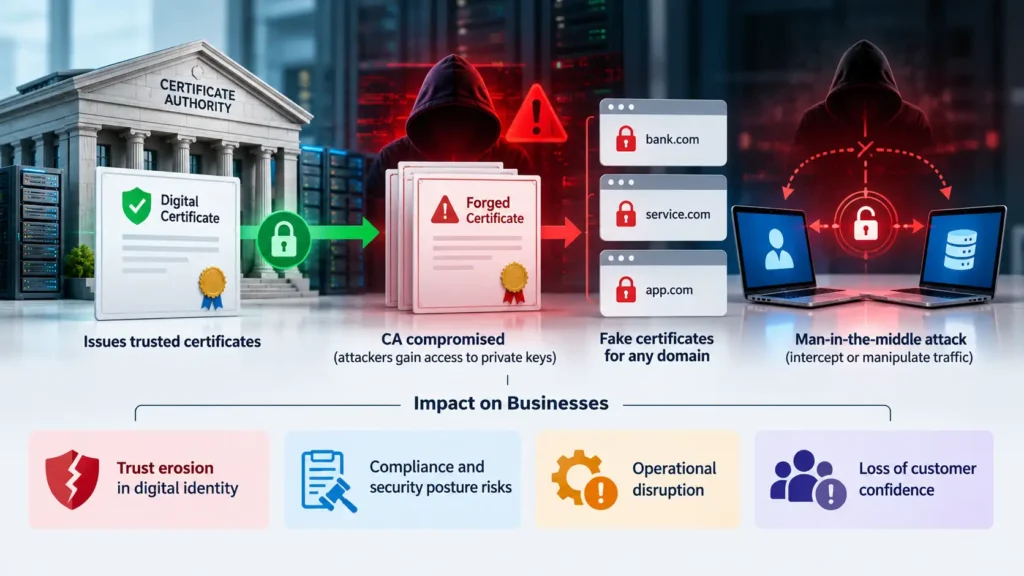
At its core, the risk lies in how digital certificates are created and trusted. Businesses expect that a certificate signed by a known CA authenticates a website, application, or entity with certainty. But if attackers gain access to a CA’s private keys, they can forge certificates for any domain, impersonating trusted services undetected. This opens the door to man-in-the-middle attacks where encrypted traffic can be intercepted or manipulated, undermining data confidentiality and integrity.
An example of such a risk became starkly apparent when multiple intermediate CA certificates under a reputable CA were compromised due to fundamental flaws in key generation processes. These compromised certificates were widely trusted by major browsers and operating systems, highlighting how a single vulnerability can ripple across millions of users and devices. The exposure forced rapid revocation actions from software vendors and triggered an urgent scramble for patching and updates.
Key Challenges for Businesses
For businesses, this breach reveals several pressing challenges:
- Trust Erosion in Digital Identity: The assurance that a website or service is genuine is paramount. Even momentary losses of confidence in certificate authenticity can damage brand reputation and customer loyalty.
- Compliance and Security Posture Risks: Many regulatory frameworks require safeguarding data in transit using robust encryption standards. A compromised CA can invalidate these protections, risking non-compliance and costly penalties.
- Operational Disruption: Reacting to certificate revocations and trust store updates often demands coordinated IT efforts. Organizations relying on outdated or unmanaged devices may remain vulnerable longer, increasing attack surfaces.
Managing Certificate Authority Risks
What does this mean practically? Organizations must shift from passive trust reliance to proactive risk management for certificate infrastructure. This includes:
Vigilant Monitoring of CA Ecosystem
Keep abreast of CA firmwares and trust store updates. Delays in patching can leave sensitive communications exposed.
Diversifying Trust Strategies
Where possible, consider layered approaches such as certificate pinning or private PKI (Public Key Infrastructure) for critical systems to reduce over-reliance on external CAs.
Automating Updates and Revocations
Use automation tools to ensure that software and devices promptly consume certificate revocation data and trust updates without manual intervention.
Validating Third-Party Trust Chains
When integrating external services, verify their certificate management rigor to avoid indirect exposure.
Educating Stakeholders
Help teams across business units understand the importance of timely security patches and the role of certificates in protecting data integrity.

Building Resilient Digital Trust
This evolving threat landscape reveals that certificate authority security can no longer be assumed as a static, bulletproof defense. Instead, it demands continuous vigilance, improved operational processes, and smarter technology use.
Businesses investing effort into strengthening these areas will not only protect data but also preserve vital market trust in their digital offerings.
At Manisoft Solutions, we see the bigger opportunity in adapting security tools and automation to real-world workflows. By integrating certificate monitoring and rapid update mechanisms into broader cybersecurity and IT operations frameworks, organizations can respond faster to CA-related threats and maintain seamless trust with their users and partners.
Ultimately, technology only delivers its value when aligned with practical business needs, and as certificate authority threats rise, managing this balance becomes essential for resilient, trustworthy digital services.
Let’s Build This Together
At Manisoft Solutions, we help businesses turn ideas like this into practical software, AI, and automation solutions. If you see an opportunity to apply this kind of technology to your business, Get a free consultation and let’s talk.