
How AI SaaS Solutions Are Revolutionizing Legal Workflows and Firm Efficiency
Legal firms have traditionally grappled with complex, labor-intensive processes that slow down case management and inflate costs. Drafting, researching, and verifying documents is often heavily manual, making it difficult for firms to maintain speed and accuracy as workloads increase. That imbalance stands out as the key business challenge that AI SaaS solutions tailored for the legal domain are now equipped to solve.

The fundamental shift underway is the rise of specialized AI platforms designed specifically for legal professionals. These solutions are far beyond generic tools , they integrate powerful AI models with tailored legal knowledge, trusted research indices, and seamless connections to the software firms already depend on. They transform manual bottlenecks into streamlined, automated workflows, turning legal expertise into scalable technology assets.
The impact on day-to-day legal work is multifaceted. AI systems can conduct in-depth legal research by sifting through hundreds of millions of cases, statutes, and regulations quickly and with high precision. This reduces the hours lawyers spend locating relevant authorities, while also enhancing the quality of legal analysis through improved accuracy and more comprehensive findings. Instead of simply retrieving information, AI augments decision-making by distinguishing nuanced legal interpretations, identifying precedent strength, and supporting tailored client advice.
Integrations with existing matter management platforms and contract analysis tools further embed AI within established workflows. Automated review of agreements using firm-specific precedent libraries enables faster risk identification and contract drafting with actionable suggestions. Data-driven deal diligence systems track key findings and questions as lawyers work through volumes of documents, accelerating transactions without compromising thoroughness.
Security and privacy play a pivotal role. Legal-grade controls allow firms to manage data confidentiality carefully, adhering to strict governance and ethical standards. This builds trust in AI’s role, ensuring it supports rather than replaces professional judgment while safeguarding client information.
Adopting AI SaaS for legal operations also opens doors to custom AI tools built around a firm’s unique expertise. Law firms can develop tailored applications that embed their playbooks, risk assessment methods, and judgment criteria directly into AI workflows. This creates a competitive edge by digitizing proprietary knowledge and making it instantly accessible and actionable across teams.
From a broader perspective, this trend signifies the growing importance of vertical AI SaaS solutions, products designed for deep specialization rather than wide generalization. Legal AI SaaS demonstrates that enterprises gain the most value when AI not only automates tasks but also integrates with domain-specific data, processes, and governance. That combination drives real operational improvements, reduces friction in adoption, and unlocks the potential to transform service delivery.
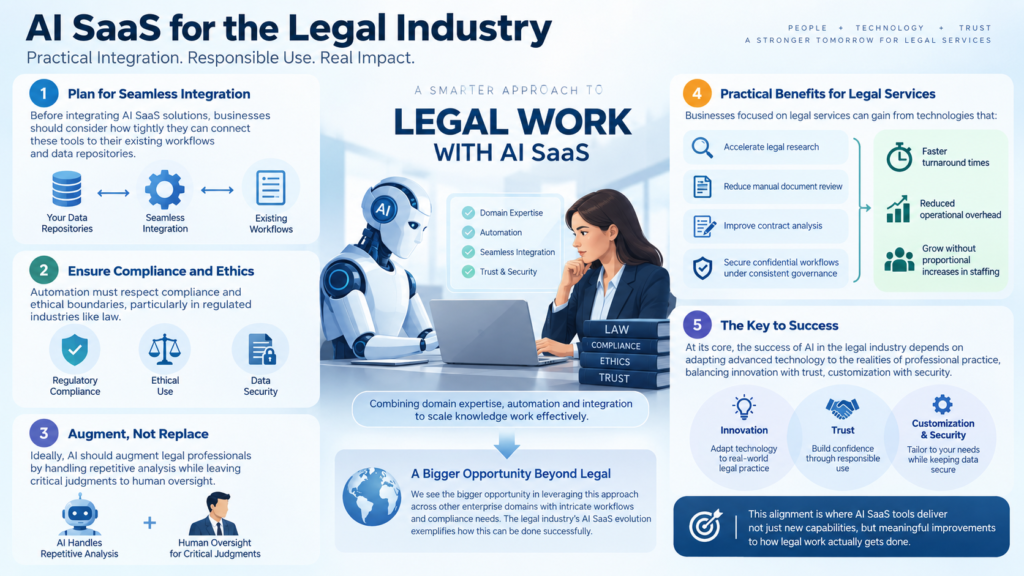
Before integrating such AI SaaS solutions, businesses should consider how tightly they can connect these tools to their existing workflows and data repositories. Automation must respect compliance and ethical boundaries, particularly in regulated industries like law. Ideally, AI should augment legal professionals by handling repetitive analysis while leaving critical judgments to human oversight.

We see the bigger opportunity in leveraging this approach across other enterprise domains with intricate workflows and compliance needs. The legal industry’s AI SaaS evolution exemplifies how combining domain expertise, automation, and seamless integration can scale knowledge work effectively.
In practical terms, businesses focused on legal services can gain from technologies that accelerate legal research, reduce manual document review, improve contract analysis, and secure confidential workflows under consistent governance. This creates faster turnaround times, reduces operational overhead, and allows firms to grow without proportional increases in staffing.
At its core, the success of AI in the legal industry depends on adapting advanced technology to the realities of professional practice, balancing innovation with trust, customization with security. This alignment is where AI SaaS tools deliver not just new capabilities, but meaningful improvements to how legal work actually gets done.
Such transformation aligns perfectly with enterprise desires to digitize and automate while maintaining control and quality. Firms adopting these AI solutions thoughtfully will likely see long-term benefits in efficiency, client satisfaction, and competitive differentiation.
Let’s Build This Together
At Manisoft Solutions, we help businesses turn ideas like this into practical software, AI, and automation solutions. If you see an opportunity to apply this kind of technology to your business, Get a free consultation and let’s talk.