
Scaling AI Automation Responsibly
The rush to integrate AI automation across businesses often runs up against a common trap: central teams become overwhelmed with requests, turning automation into a bottleneck rather than a productivity driver. The challenge isn’t just adding more workflows , it’s how to expand automation capabilities responsibly without sacrificing governance, quality, or long-term reliability.
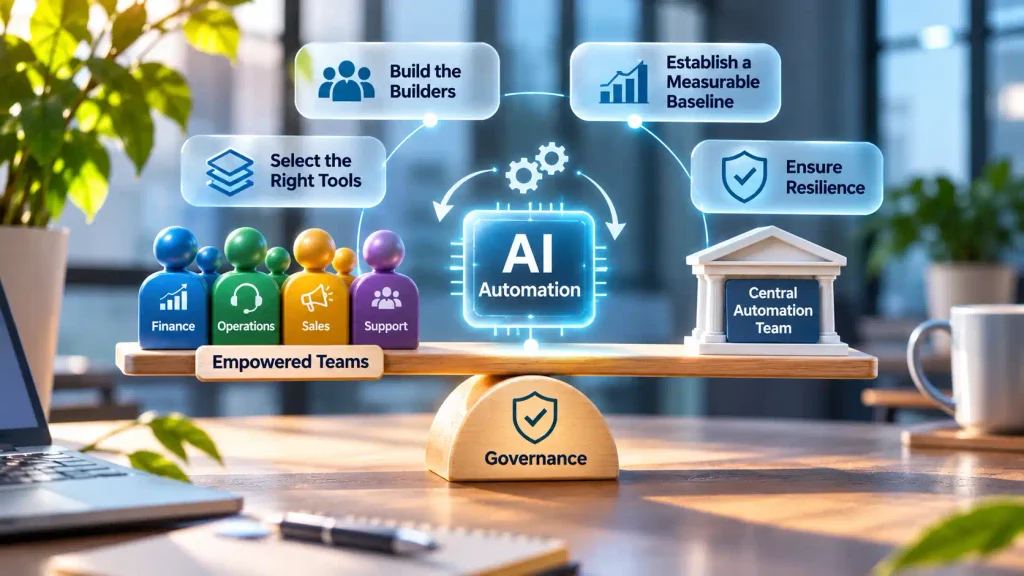
A fundamental shift is underway: instead of concentrating automation development as a service desk that fulfills requests, leading organizations are adopting a team enablement model. This approach empowers departments to build and own their own automations, supported by a central automation function that handles complex, high-risk, or cross-departmental workflows while setting clear standards for everyone else.
Why does this matter? When frontline teams , the ones with the deepest domain knowledge , have the tools and guidance to create automations, improvements happen faster and more contextually. For example, finance teams understand their own approval chains and reporting needs far better than a distant central team. Enabling these teams to build workflows directly can reduce manual handovers and speed up processes, making automation more relevant and impactful.
Four Key Principles for Responsible AI Automation
However, broadening access without guardrails risks a jumble of fragile one-off workflows that increase operational burden. That’s where a structured framework comes into play, balancing innovation with oversight. Four key principles support responsible scaling of AI automation within teams:
- Build the Builders , Equip teams with training, reusable templates, and champions who understand both the business process and the automation tools. This creates internal expertise that extends beyond a central squad.
- Establish a Measurable Baseline , Before automating, teams quantify the current state and define clear improvement goals. This discipline ensures automation delivers actual process gains, not just digital duplicates of inefficient workflows.
- Select the Right Tools , Instead of defaulting to always building new AI agents or internal scripts, teams evaluate whether proven external solutions better fit the problem. This minimizes maintenance risk and leverages existing innovation.
- Ensure Resilience , Every automation must have documented ownership, error handling, and a continuity plan. This safeguards against silent failures and ensures workflows remain dependable as teams and needs evolve.
The Business Impact of Team Enablement
Adopting this model changes the measure of success from the volume of workflows delivered to the capability of teams to independently improve and sustain their processes. It transforms automation from a bottlenecked service request list into a distributed capability embedded in the business.
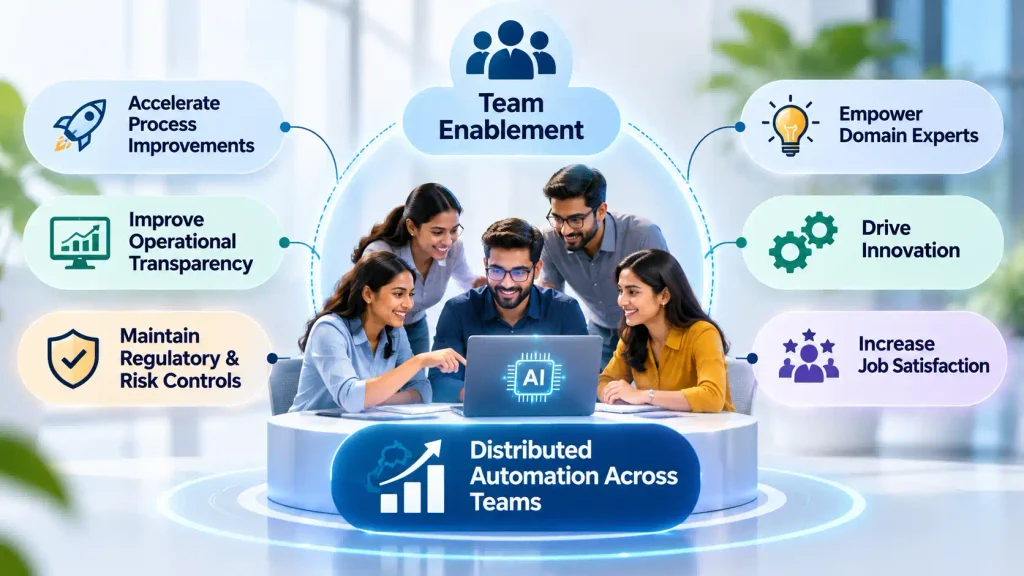
The practical implications are significant. Businesses can accelerate day-to-day process improvements without overloading central teams, improve operational transparency, and maintain regulatory and risk controls through clear ownership and documentation. It also fosters a culture where domain experts feel empowered to leverage AI for their unique challenges, increasing innovation and job satisfaction.
Before embarking on such a shift, organizations should consider nurturing department-level automation champions who can bridge central expertise and daily operations. These champions help interpret standards, leverage reusable assets, and escalate work that requires specialized skills or cross-team coordination.
Building a Responsible AI Automation Framework
In essence, scaling AI automation responsibly is not about giving unrestricted access to every tool but about distributing capabilities with discipline. Governance frameworks must blend flexibility with guardrails, ensuring that automation remains a reliable, scalable asset.
From this perspective, technology providers and development partners play a crucial role by adapting AI solutions into structured operating models that emphasize team enablement, measurable impact, and resilience , rather than just feature delivery.
When thoughtfully embedded in workflows and matched with governance, AI-driven automation can transition from a promising experiment into a core driver of continued business efficiency and ethical operation.
Let’s Build This Together
At Manisoft Solutions, we help businesses turn ideas like this into practical software, AI, and automation solutions. If you see an opportunity to apply this kind of technology to your business, Get a free consultation and let’s talk.