
The Future of Efficient AI Architectures for Business
The rise of transformer models marked a significant leap in AI capabilities, powering everything from language understanding to advanced automation. However, as these models have grown in size and complexity, they bring challenges that businesses cannot ignore, namely high computational costs and limitations in certain real-world applications.
The question now is whether there’s a better way forward for AI architectures that could unlock greater efficiency and performance tailored for practical business use.
Recent developments indicate that the dominance of transformers might face disruption by innovative model designs that move away from traditional self-attention mechanisms.
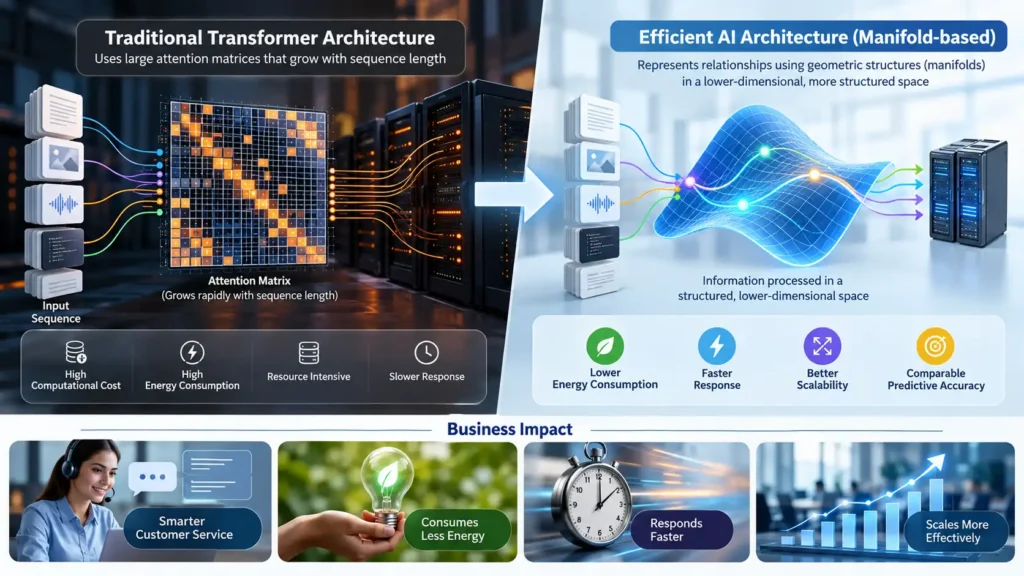
Instead of relying on large attention matrices that grow resource demands exponentially with sequence length, these new architectures explore alternative mathematical frameworks to process information more efficiently.
Rethinking How AI Processes Information
One such promising direction rethinks how AI systems encode and manipulate data.
Rather than mapping interactions into vast, complex tensor spaces as transformers do, emerging models represent relationships using geometric structures called manifolds.
This shift enables information to propagate through controlled transformations in a lower-dimensional, more structured space.
The benefit? Significantly reduced computational overhead without a drastic sacrifice in predictive accuracy.
For businesses, this shift could translate directly into smarter AI software that:
- Consumes less energy
- Responds faster
- Scales more effectively across various applications
These applications range from natural language understanding to automating complex decision workflows.
Imagine automating customer service interactions with AI models that offer comparable understanding but operate less expensively and integrate more seamlessly into existing systems.
Improving Interpretability and Business Efficiency
Moreover, a move toward these alternative AI architectures opens the door for clearer interpretability.
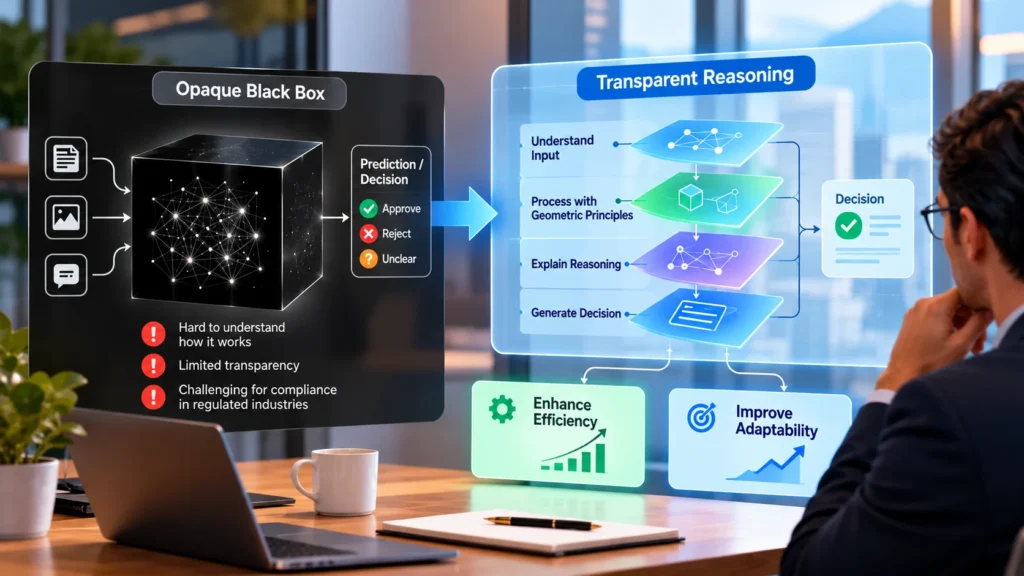
Current transformer models often act as opaque black boxes, which can complicate trust and compliance in sectors like finance or healthcare.
Architectures grounded in geometric principles could provide more transparent reasoning pathways, supporting better governance around automated decisions.
Anticipating this shift is critical for businesses planning long-term AI investments.
Instead of committing exclusively to transformer-based solutions, organizations should begin evaluating how emerging architectures might be integrated into their platforms to:
- Enhance efficiency
- Improve adaptability
This forward-looking approach reduces risk associated with rapidly evolving AI technologies and positions companies to leverage next-generation capabilities as they mature.
Building AI Around Real Business Workflows
Ultimately, the true value of these new AI architectures lies in their alignment with real business workflows and challenges.
Technology gains impact when they bridge gaps in existing processes, including:
- Cutting down manual data handling
- Speeding insights extraction
- Reliably automating decisions formerly requiring human intervention
By adopting architectures that deliver these outcomes more sustainably, businesses can future-proof their AI initiatives while gaining tangible operational advantages.
Approaching AI development with this strategic mindset ensures that investments do not just chase the latest innovations, but create lasting improvements.
As AI evolves beyond transformers, the opportunity to build better, leaner, and more responsible AI-powered software solutions becomes tangible.
This change promises not only to refine how automation works but to expand where AI can effectively add value in business environments.
Let’s Build This Together
At Manisoft Solutions, we help businesses turn ideas like this into practical software, AI, and automation solutions.
If you see an opportunity to apply this kind of technology to your business, Get a free consultation and let’s talk.